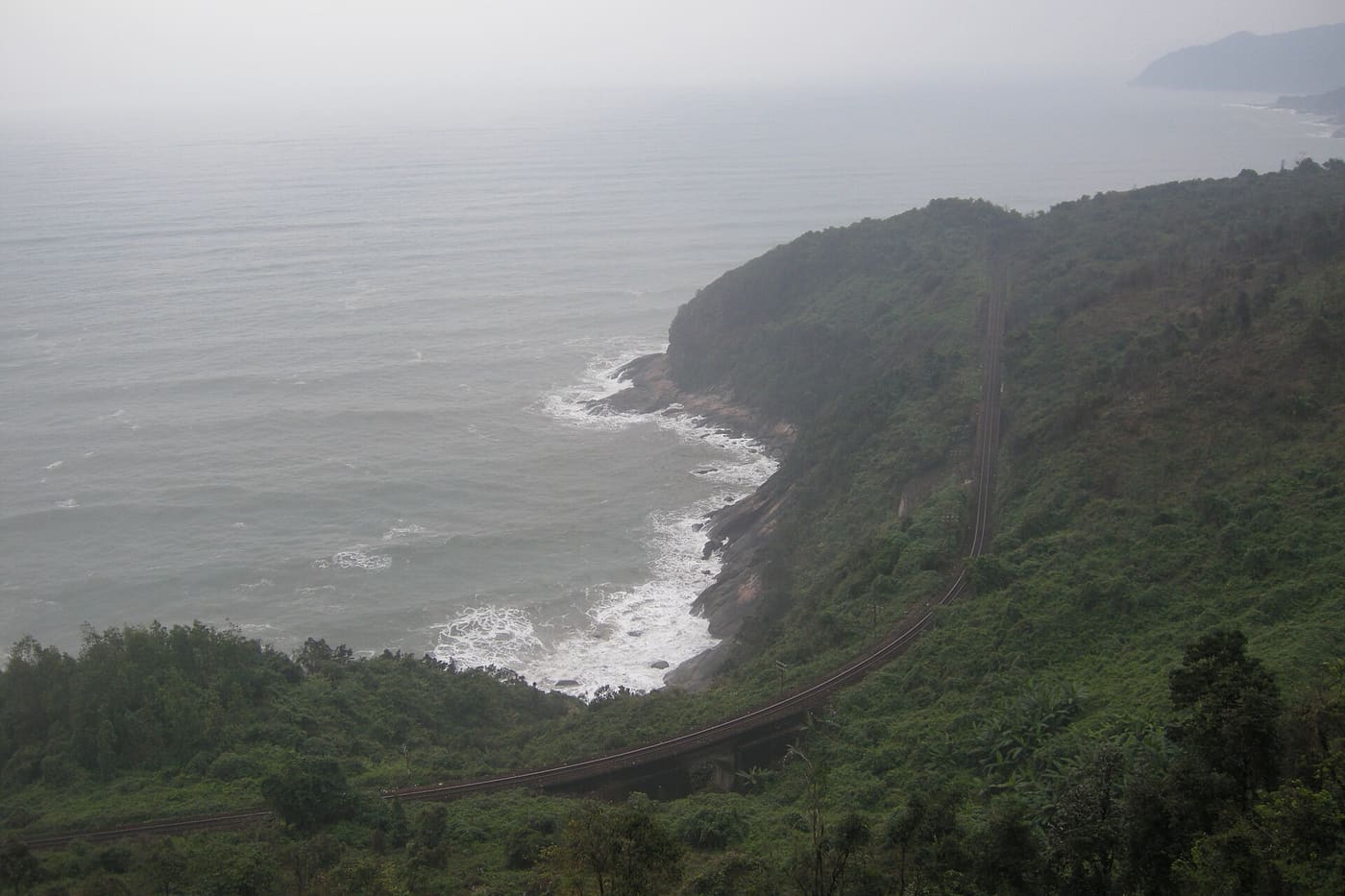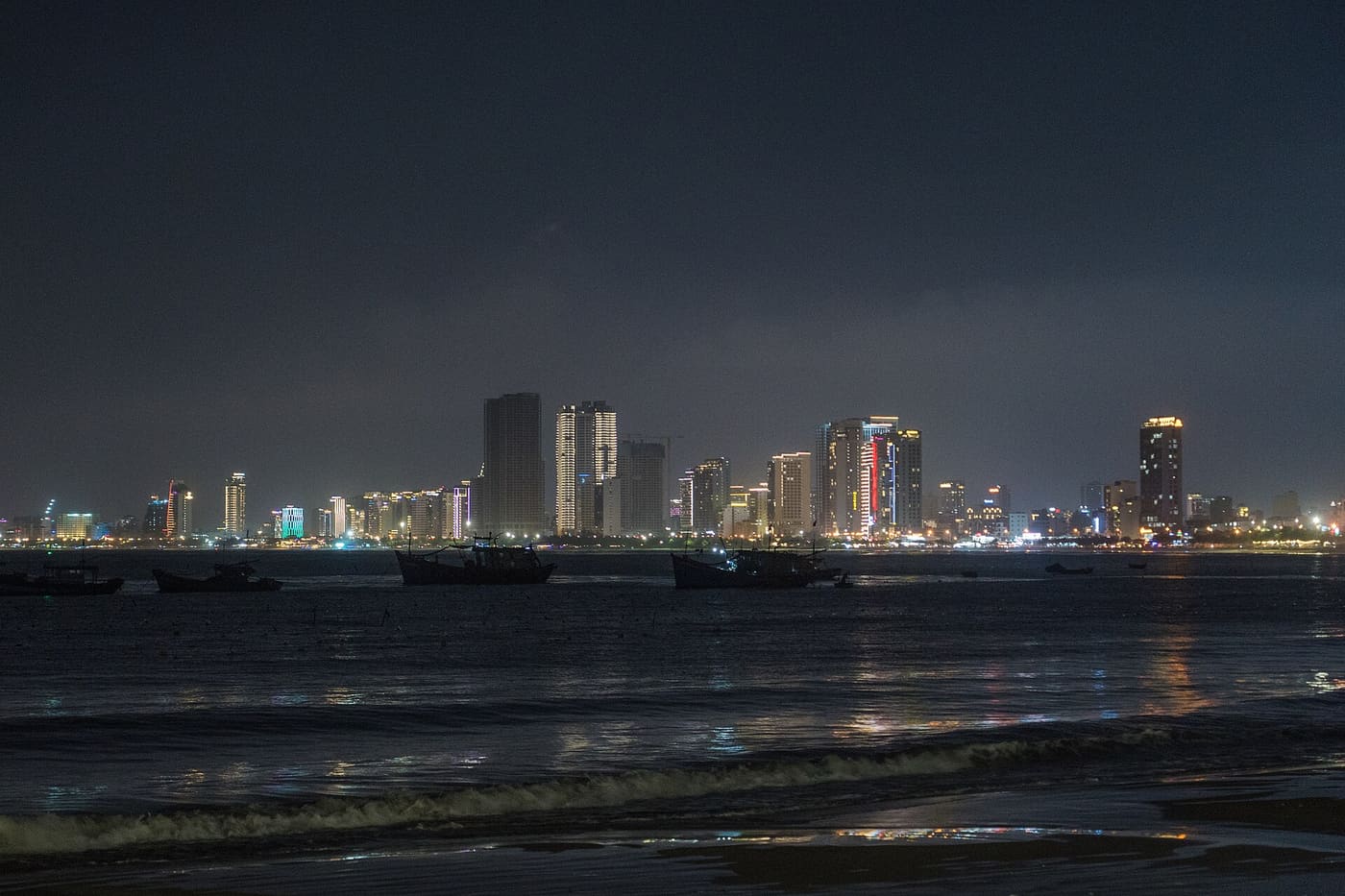
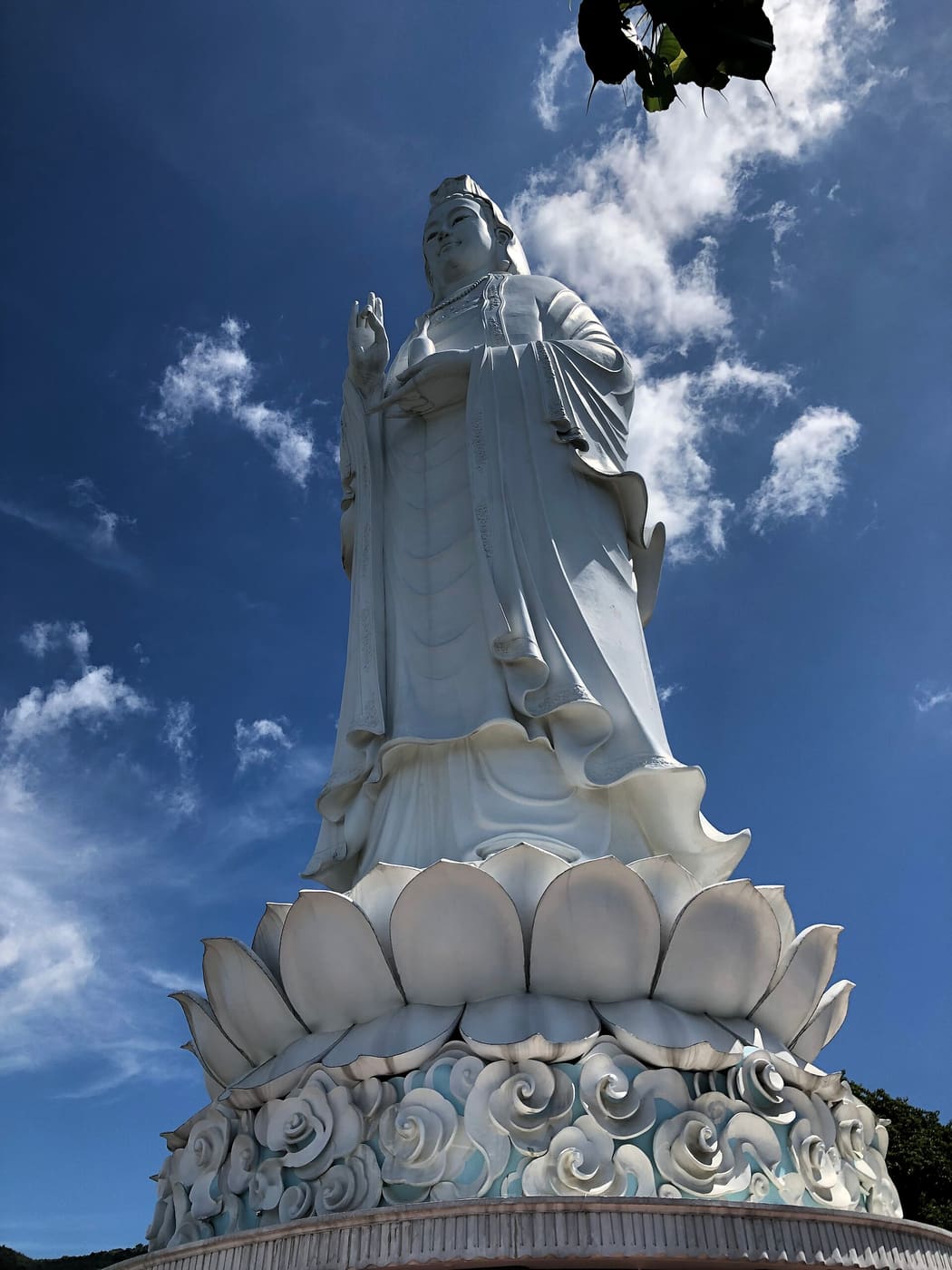
Look from My Khe beach towards the Son Tra Peninsula and you will see a white figure standing on the hillside, facing the sea. That is the Lady Buddha at Linh Ung Pagoda — 67 metres tall, and visible from almost anywhere along the Da Nang coast.
Linh Ung is the most visited religious site in the city, and also the one people rush most: a few photographs in the front courtyard and back to the car. This guide covers what deserves your time, how to behave, and the best hour to arrive.
Where it is
The pagoda stands at Bai But on the southern slope of the Son Tra Peninsula, about 10 km from central Da Nang and fifteen minutes from My Khe beach. The road up is well surfaced and easy for both cars and scooters — it is not the steep climb that leads further on to Ban Co Peak.
| From | Time |
|---|---|
| My Khe beach | 15 min |
| City centre | 20 min |
| Da Nang airport | 25 min |
Entry and parking are free. The pagoda opens from early morning until early evening.
A note on the name
Da Nang has three pagodas called Linh Ung: at Bai But on Son Tra, at the Marble Mountains, and up at Ba Na Hills. When people say "Linh Ung Pagoda" they usually mean the Son Tra one, with the large statue. Say "Linh Ung Bai But" when booking a car, so you are not taken to the wrong one.
A short history
Construction began in 2004 and the pagoda was completed in 2010 — this is a modern temple, not an ancient one. What draws people is not its age but its scale, its position and its view.
The name means roughly "answered prayers". For Da Nang's fishing families the statue facing the sea has a very concrete meaning: protection for boats going out. That is why locals come here all year, not only on festival days.
What makes it worth stopping for
The 67-metre statue
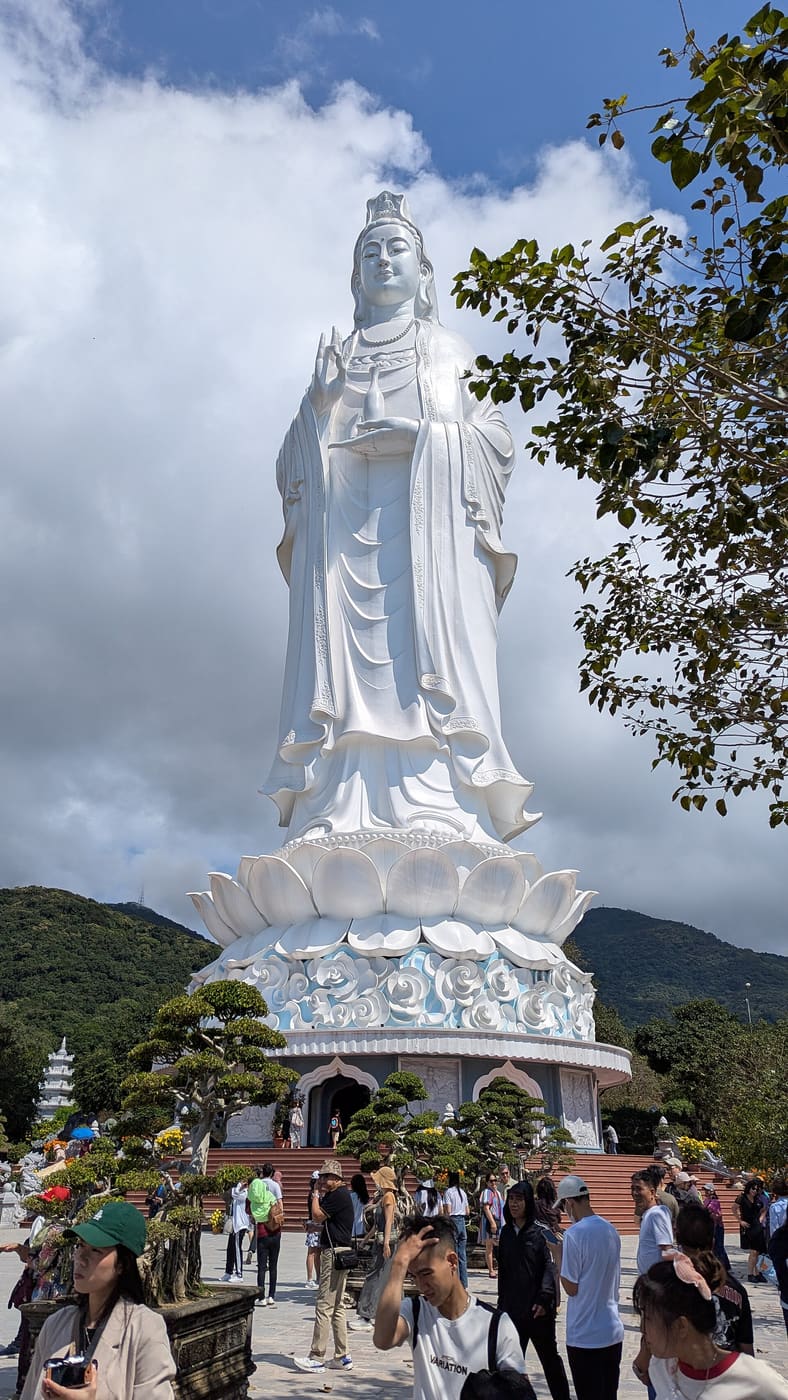
The centrepiece. The figure stands on a lotus pedestal at 67m — about the height of a twenty-storey building — and is regarded as the tallest statue of its kind in Vietnam. From a distance it stands out white against the green hillside.
| Detail | Figure |
|---|---|
| Height | 67m |
| Lotus pedestal diameter | About 35m |
| Floors inside | 17, each with an altar |
| Facing | The East Sea |
| Completed | 2010 |
The view
From the courtyard you see the whole bay, the beach running south, and on a clear day the coastline curving towards Hoi An. It is one of the best views in Da Nang and it costs nothing.
The quiet
Even when busy, the grounds are large and shaded enough to stay calm — particularly in the statue garden at the back. If the front feels crowded, walk further in; most visitors never do.
The architecture
Traditional Vietnamese Buddhist forms — curved roofs, glazed tiles — built at modern scale and in modern materials. The result feels both familiar and monumental.
What to see in the grounds
The triple gate
The main entrance and the first photo stop. Step well back to get both the gate and the statue behind it in one frame.
The main hall
Dedicated to Sakyamuni Buddha. Quiet inside, and open for prayer. Remove hats, speak softly, and do not photograph people who are praying.
The arhat garden
Eighteen stone arhats, each with a different posture and expression. This is the most overlooked and most interesting corner of the site — walk the whole row and look at the faces.
Around the base of the statue
Walk around the lotus pedestal to grasp the real scale. It is also the best sea view on the grounds.
The gardens
Bonsai and mature trees, with stone benches in the shade — a good place to sit for fifteen minutes before continuing up to Ban Co Peak.
When to visit
| Time | Good | Less good |
|---|---|---|
| 6–8am | Cool, very quiet, lovely light, langurs on the road up | An early start |
| 8–10am | Bright and clear, best sea view | Filling up |
| 10am–3pm | — | Hot, busiest, and the courtyard has no shade |
| 4–6pm | Soft light, sunset over the city | Leaving late means driving Son Tra in the dark |
By season: March to August gives the clearest, longest views. The pagoda is still easy to reach in the rainy season — the road is good — but visibility suffers.
Dress and conduct
This is a working temple, not a photo location. A few basics:
- Cover shoulders and knees. Vests, shorts and short skirts may be stopped at the gate.
- Remove hats in the main hall, speak quietly, silence your phone.
- Do not photograph people praying, and no flash inside.
- Do not climb on statues or plinths to pose.
- No food or drink in the worship areas.
Fitting it into your day
The usual half-morning on Son Tra
| Time | What you do |
|---|---|
| 6.00 | Leave the hotel; forest road, watching for langurs |
| 7.00 | Ban Co Peak — the city in early light |
| 8.15 | The thousand-year banyan |
| 9.15 | Linh Ung Pagoda — allow at least 45 minutes |
| 10.30 | Coffee with a sea view on the way down |
| 11.30 | Back in the city for lunch |
Other combinations
- Pagoda plus a swim at My Khe — the easiest half-day of your trip.
- Pagoda in the afternoon, Dragon Bridge in the evening — good for arrival day.
- Son Tra in the morning, Marble Mountains in the afternoon — a full cultural day with little driving.
Give the pagoda itself 45–60 minutes. Fifteen minutes buys you only the front courtyard.
Costs
| Item | Cost |
|---|---|
| Entry | Free |
| Parking | Free |
| Incense and offerings (optional) | 0 – 100,000₫ |
| Return Grab from the beach hotels | 200,000 – 300,000₫ |
Common mistakes
- Arriving at midday. The courtyard is wide, unshaded and very hot.
- Dressing too briefly. Many visitors end up borrowing a wrap at the gate.
- Staying in the front courtyard. The arhat garden and the base of the statue are the parts worth seeing.
- Giving it fifteen minutes. Once you are up on Son Tra, add Ban Co Peak and the banyan too.
- Confusing it with the Marble Mountains pagoda. Say "Linh Ung Bai But".
Frequently asked questions
Is there an entrance fee?
No. Entry and parking are both free.
How tall is the statue?
67 metres on its lotus pedestal — regarded as the tallest of its kind in Vietnam.
Can I go inside the statue?
There are 17 floors inside, each with an altar. Whether they are open to visitors varies, so ask at the pagoda when you arrive.
What time should I go?
6–9am, or after 4pm. Avoid 10am to 3pm, which is both hot and busy.
How long does a visit take?
45–60 minutes for the grounds; half a day if you combine it with the rest of Son Tra.
What should I wear?
Sleeved top, trousers or a skirt below the knee, and comfortable shoes — the site is large.
Is the road hard on a scooter?
No. The climb to the pagoda is moderate and well surfaced. The difficult stretch is further on, up to Ban Co Peak.
Can I get a Grab there?
Yes, going up. Coming back is harder, which is why many visitors either keep a car waiting or hire a private one.
Is it suitable for children and older visitors?
Yes. The grounds are mostly level with only a few short flights of steps.
Can I pray and make offerings?
Yes. It is an active temple; locals come daily. Just keep a respectful manner.
Until what time is it open?
Generally until early evening — but do not come down Son Tra after dark, as the road is unlit.
Is there anywhere to eat nearby?
A few sea-view cafés on the way up and down. For a proper meal, go back into the city.
Where are the best photographs?
From the front courtyard with the statue against the sea; from the base of the pedestal shooting upwards; and from the triple gate, framing both gate and statue.
In short
Linh Ung is worth the trip for three concrete reasons: a statue of unusual scale, a full view over the bay of Da Nang, and a pocket of quiet twenty minutes from the centre — all of it free.
Remember two things: come early, and walk the whole site instead of stopping at the front courtyard.
Da Nang Rider runs half-day trips over Son Tra — the pagoda, Ban Co Peak and the ancient banyan — along with airport transfers and routes to Ba Na, Hoi An, My Son and Hue. See the price list · Message us.
Read next: The Son Tra Peninsula guide · The Marble Mountains · Da Nang travel guide